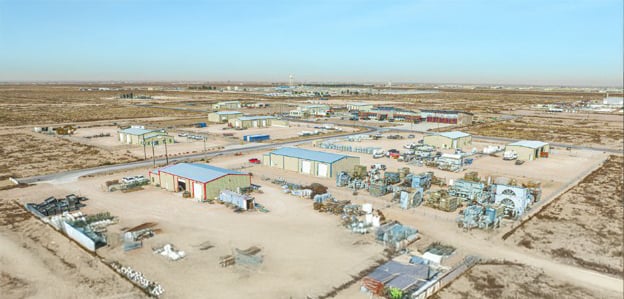
Businesses searching for Reeves County, Texas, land for sale are usually looking for more than acreage. In an active industrial and energy market, the right site needs to support the way a business operates today while leaving room for future growth. Location, access, site configuration, infrastructure, and intended use can all influence whether a parcel is truly a practical fit.
For companies serving the O&G, energy generation or data center businesses situated in the Delaware Basin, Reeves County offers the strategic location. But choosing the right industrial site requires looking beyond the county name and evaluating what a particular property can actually accommodate.
Start With Your Business Requirements
Before comparing available land, define what the property needs to accomplish.
An industrial site might need to accommodate warehouses, service facilities, equipment yards, offices showrooms, meeting rooms, repair operations, transportation activity, or a combination of uses. The amount of land required can vary considerably depending on the business.
Consider factors such as:
- Building footprint
- Equipment and vehicle storage
- Employee and visitor parking
- Truck circulation
- Loading and unloading areas
- Outdoor storage
- Future expansion
- Utility requirements
- Transportation access
The acreage that appears sufficient on paper may become restrictive once these operational needs are mapped onto the site.
That is why evaluating land based solely on price per acre can be misleading. A slightly larger or better-configured site may provide considerably more functional value for an industrial operation.
Location Matters Beyond the County Line
Reeves County is the heart of the Delaware Basin in Texas, part of the larger Permian Basin. The Texas Railroad Commission identifies the Permian as a major oil-and-gas-producing region of West Texas and notes significant development in the Delaware Basin, including the Bone Spring and Wolfcamp formations.
For businesses supporting energy production and related industries, proximity to customers, suppliers, transportation routes, and regional infrastructure can therefore be an important consideration.
Pecos is particularly relevant because it provides an established commercial base within the Delaware Basin. First, Keystone’s Pecos Industrial Park positions its sites around access to major highways, industrial activity, rail connectivity, and nearby airport infrastructure.
For an industrial buyer, the question is not simply, “How much land can I get?” It is also, “How efficiently can this location support my operation?”
Evaluate Access for the Equipment You Actually Use
Industrial property needs to work for the vehicles and equipment moving through it.
A location that looks convenient on a map may present practical limitations once large trucks, trailers, heavy equipment, or frequent deliveries are involved. Site access, road conditions, turning areas, and proximity to major transportation routes can all affect daily operations.
Think through a typical day on the property.
How will trucks enter and exit? Where will equipment be staged? Can deliveries move through the site without interfering with employees or other operations? Is there enough room for future changes to traffic patterns?
Answering these questions before purchasing can help prevent expensive site modifications later.
Look at Site Configuration, Not Just Acreage
Two parcels with the same acreage can have very different practical value.
Shape, frontage, grade, existing improvements, access points, and usable area can all affect how efficiently a site can be developed. A parcel may technically provide enough square footage while still leaving limited room for buildings, parking, storage, or circulation.
For businesses considering Reeves County, Texas, land for sale, it is worth examining the entire site plan rather than relying on the advertised acreage alone.
If the intended property will eventually support a warehouse, shop, office, equipment yard, or regional headquarters, consider where each component could realistically fit.
Understanding Reeves County, Texas, Land for Sale Before You Buy
Industrial operations can have infrastructure requirements that differ substantially from those of residential or conventional commercial properties.
Depending on the planned use, buyers may need to evaluate:
- Electrical capacity
- Water availability
- Wastewater or septic considerations
- Natural gas access
- Telecommunications
- Drainage
- Road improvements
- Rail access
- Site grading
Availability does not necessarily mean capacity is adequate for a particular operation. Businesses should confirm requirements with the appropriate utility providers, local authorities, engineers, and other qualified professionals before relying on assumptions about a property’s infrastructure.
The same principle applies to permitting and development requirements. A parcel’s current condition does not automatically mean every intended use can proceed without additional approvals.
Consider How the Delaware Basin Shapes Demand
The broader Delaware Basin economy is an important factor when evaluating industrial property in Reeves County.
The region’s energy activity supports demand for businesses involved in services, equipment, transportation, maintenance, logistics, and other industrial functions. First Keystone specifically markets its Pecos Industrial Park toward businesses needing industrial buildings and sites connected to Delaware Basin operations.
At the same time, buyers should avoid assuming that regional growth automatically makes every parcel a good investment.
Land value still depends on the individual property’s characteristics, permitted uses, access, infrastructure, market conditions, and acquisition cost. A strong regional story can create opportunity, but due diligence determines whether a particular site makes sense.
Think About Expansion Before You Need It
Industrial businesses rarely stay exactly the same size forever.
Additional employees may require more parking. Larger equipment may require additional yard space. A growing customer base may increase shipping and storage requirements. A successful operation may eventually need another building.
Planning for expansion at the beginning can make future growth considerably easier.
When reviewing Reeves County, Texas, land for sale, consider not only whether the site meets today’s requirements but also whether it gives the business room to evolve.
That does not necessarily mean buying the largest available tract. It means understanding the company’s likely growth trajectory and matching the property to that outlook.
Compare Land With the Total Cost of Development
The purchase price is only one component of an industrial site’s overall cost.
Depending on the property and intended use, development expenses may include site preparation, grading, utilities, roads, drainage, fencing, paving, building construction, permitting, engineering, and other improvements.
A lower-priced parcel may require substantial investment before it becomes operational. Conversely, a site with existing improvements or a more development-ready configuration may offer value that is not immediately obvious from its asking price.
A realistic evaluation should therefore consider the total cost of getting the property ready for business, not just the land acquisition price.
Make the Site Work for the Business
The best industrial property is not necessarily the cheapest parcel or the largest tract. It is the site that aligns with the company’s operational requirements, transportation needs, infrastructure, growth plans, and budget.
For businesses evaluating Reeves County, Texas, land for sale, Pecos and the surrounding Delaware Basin provide a setting worth considering for industrial and energy-related operations. First Keystone’s Pecos Industrial Park offers industrial land configurations intended for uses such as offices, warehouses, repair and maintenance facilities, storage, transportation, and regional headquarters.
Ultimately, the right property decision comes down to fit. Define your operational requirements, investigate access and infrastructure, verify permitted uses, evaluate development costs, and conduct appropriate professional due diligence before purchasing.
When the land works for the business, not simply on paper, but in day-to-day operations, it can become a foundation for long-term growth.